
As a DJ and a true music obsessive, when people ask me “what is acid house?” I tell them it’s more than just a music genre. It’s a sonic revolution. At its core, acid house is an electrifying subgenre of house music. It emerged in the mid-1980s. Its defining characteristic is the hypnotic, squelchy sound. This unique sound comes from the iconic Roland TB-303 Bass Line synthesizer. It created a raw, psychedelic energy. This energy captivated dancefloors. It changed electronic music forever. My own experience spinning tracks has shown me its incredible staying power.
The Birth of a Sound: Chicago’s Influence
Acid house didn’t just appear. It was born in the vibrant club scene of Chicago. This city was the birthplace of house music itself. DJs were constantly experimenting. They pushed boundaries with new sounds. I’ve studied this history extensively. It’s clear that these creative minds laid the groundwork for everything that followed.
The Roland TB-303: A Happy Accident
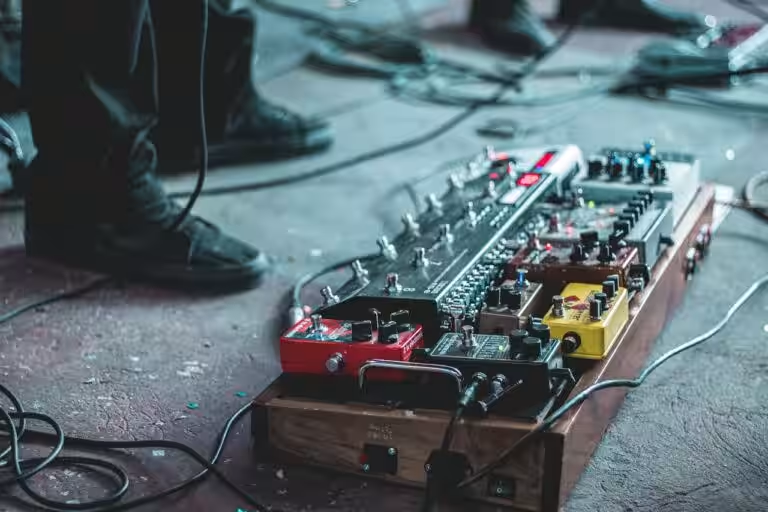
The heart of acid house is undoubtedly the Roland TB-303. This small silver box was designed for guitarists. It was meant to simulate a bass guitar. But it failed commercially in its original purpose. DJs and producers bought them up cheap. They then discovered its true potential. My research into its history always fascinates me. They didn’t use it as intended. Instead, they twisted its knobs. They manipulated its filters. This produced wild, resonant, and often bizarre sounds. These sounds were perfect for the dancefloor. This “misuse” created something entirely new.
Early Pioneers: DJ Pierre and Phuture
You can’t talk about acid house without mentioning its pioneers. DJ Pierre, with his group Phuture, is credited with creating one of the first acid house tracks. Their 1987 release, “Acid Tracks,” was a revelation. I remember hearing stories about its impact. It stunned club-goers. It sent shivers down their spines. It was raw and repetitive. It was utterly captivating. This track showcased the TB-303‘s power. It sparked a new movement. Other Chicago artists quickly followed suit. They embraced the sound. The scene exploded from there.
What Makes Acid House, Acid House?
Understanding acid house means understanding its core sonic elements. It’s distinct. It’s unmistakable. I’ve often broken down these elements for aspiring producers. They are key to its identity.
That Signature “Squelch”
The most defining characteristic is the “squelch.” This sound is often described as rubbery. It’s liquid-like. It’s sometimes metallic. It’s the sound of the TB-303’s filter being swept. It’s manipulated in real-time. This creates a constantly evolving texture. It’s incredibly psychedelic. My ears always perk up when I hear that familiar squelch. It’s like a call from the past.
Hypnotic Rhythms and Repetition
Acid house tracks are built on repetition. This is not a bad thing. It’s a key part of its hypnotic appeal. Simple bass lines repeat and evolve slowly. Drum patterns are often stripped back. This creates a trance-like state. Dancers can lose themselves in the groove. My own experience as a DJ confirms this. Repetition works wonders on a crowded floor.
The Four-on-the-Floor Beat
Like most house music, acid house uses a “four-on-the-floor” beat. This means a kick drum hits on every beat. It’s steady. It’s driving. This provides a solid foundation. It anchors the wild TB-303 sounds. It makes the music irresistibly danceable. I’ve found this simple beat to be incredibly effective. It’s a core element of electronic music.
Beyond the Music: A Cultural Phenomenon
Acid house wasn’t just sounds. It was a cultural force. It shaped a generation. It changed nightlife forever. My own connection to music history runs deep. I’ve seen how influential these movements can be.
The Rise of Rave Culture
Acid house fueled the explosion of rave culture. These parties were often underground. They were held in warehouses. They happened in fields. They offered an escape. People came together. They danced all night. The music provided the soundtrack for freedom. My research shows how vital this connection was. It created a community.
The UK Takeover
The sound quickly crossed the Atlantic. It exploded in the UK. The “Second Summer of Love” in 1988 was a direct result. Thousands of young people embraced the music. They adopted its symbols. The iconic smiley face became synonymous with acid house. I’ve seen countless flyers from that era. They all feature that distinctive symbol. It represents joy and unity.
Fashion and Iconography
The culture also developed its own style. Bright colors, baggy clothes, and the smiley face were everywhere. It was a visual representation of the music’s energy. It was about peace, love, unity, and respect (PLUR). This ethos resonated deeply. It created a powerful, unified identity.
My Take: The Enduring Legacy of Acid House
For me, acid house is more than just a historical genre. It’s a living, breathing influence. Its impact echoes throughout modern electronic music. I constantly hear its sounds in new tracks. Producers still experiment with the TB-303. Or they use emulations of it. Its raw, unfiltered energy remains relevant. It inspires countless artists. It continues to get people moving. Acid house taught us to embrace imperfection. It showed us that “mistakes” can create magic. It reminds us of music’s power. It unites people on the dancefloor. It’s a timeless sound. It will continue to ignite passion for generations to come. My experience behind the decks proves this every single time.