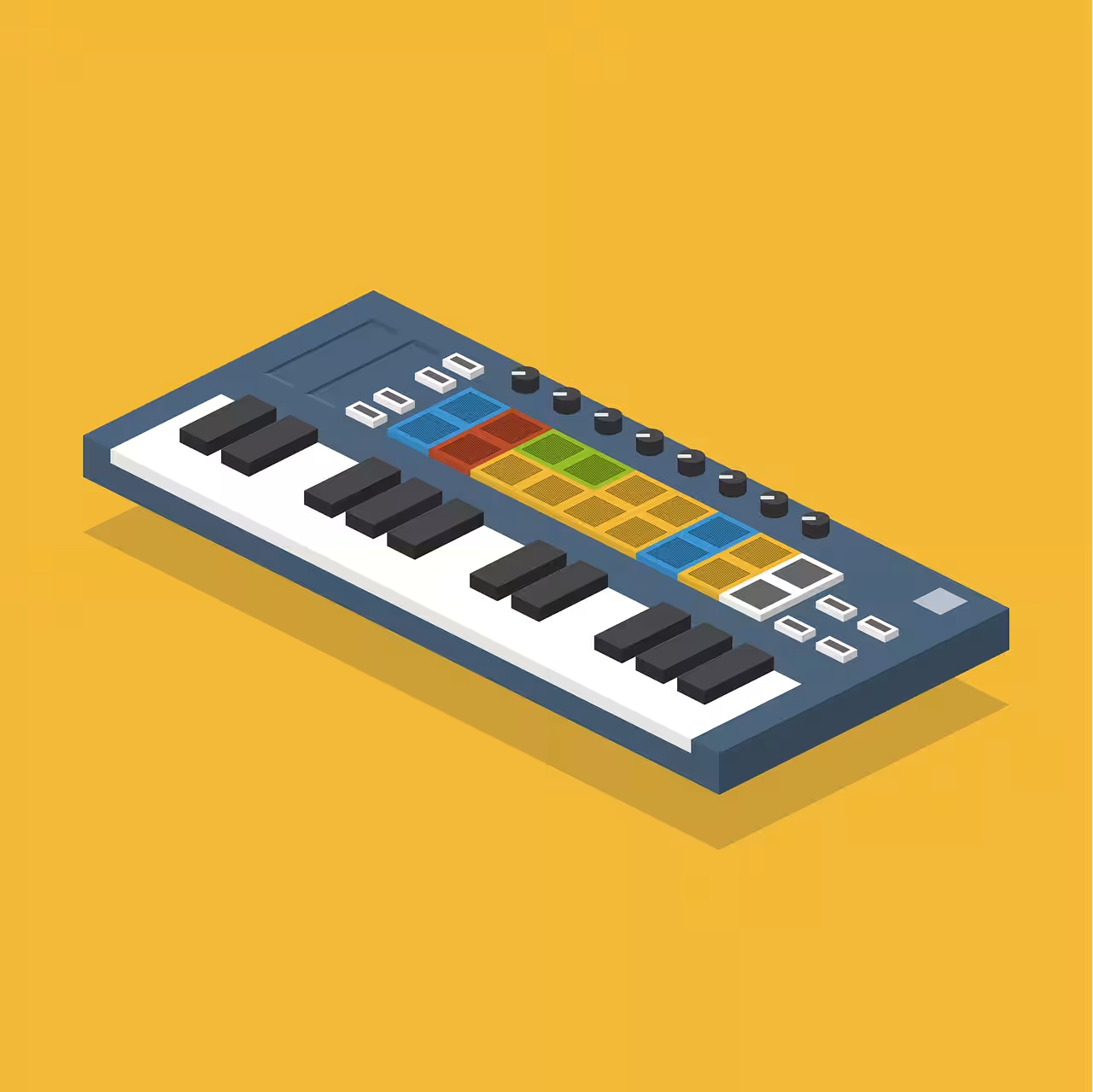

Choosing the best MIDI controller for orchestral composing in 2026 is critical. The right tool enhances your workflow significantly. My research and personal experience point to a few standout options. For sheer expressive control and deep integration, the Native Instruments Komplete Kontrol S88 MK4 (anticipated) will likely remain a top contender. The Arturia KeyLab 88 MkIII (also anticipated) will offer a fantastic blend of premium keybed and versatile controls. For the ultimate in MPE expressiveness, the ROLI Seaboard RISE 3 (future version) will redefine performance. These controllers combine superior key feel, extensive control options, and cutting-edge features crucial for cinematic and orchestral work. They are the instruments I consistently recommend for serious composers.
Key Considerations for Orchestral MIDI Controllers in 2026
The landscape of MIDI controllers evolves rapidly. In 2026, orchestral composers demand more than just keys. They need tools that seamlessly translate musical ideas into detailed performances. My journey as a composer taught me this valuable lesson. I spent years grappling with controllers that limited my expression. My research shows specific features are non-negotiable for serious orchestral work.
Keybed Quality and Feel
This is arguably the most important factor. An orchestral composer needs a realistic playing experience. A poor keybed stifles expression immediately. I always prioritize a high-quality keybed.
- Weighted Hammer Action: This simulates a real piano. It provides crucial tactile feedback. It allows for nuanced velocity control. Many orchestral libraries rely on this responsiveness. My hands always feel more connected to the sound with weighted keys.
- Aftertouch: This feature is essential for dynamic control. Channel aftertouch affects all notes. Polyphonic aftertouch affects individual notes. It allows for subtle vibrato or swells after a note is struck. I find it indispensable for string and brass sections.
- Number of Keys: An 88-key controller offers the full range. This is ideal for two-handed playing. It’s perfect for sketching grand orchestral passages. Smaller controllers (61 or 49 keys) are good for portability. They also fit smaller studios. I often recommend 88 keys for dedicated orchestral work.
Control Surfaces: Faders, Knobs, and Buttons
Orchestral libraries are complex. They feature dozens of articulations and dynamic layers. My experience shows that direct control is vital. Mapped controls speed up your workflow significantly.
- Faders: Multiple faders are excellent for dynamics. They control expression (CC11), vibrato, and individual instrument levels. I use them constantly for balancing sections.
- Knobs: Assignable knobs manage parameters like attack, release, and reverb. They offer precise, tactile control. I often map them to essential envelope controls.
- Buttons and Pads: These are perfect for articulation switching. You can map them to keyswitches. Pads can trigger percussion or short samples. I find dedicated buttons save countless mouse clicks.
Pedal Inputs
Pedals are not just for pianists. They are crucial for orchestral expression. I always ensure a controller has ample pedal inputs.
- Sustain Pedal (CC64): This is standard. It holds notes after you release the keys. Essential for legato phrasing.
- Expression Pedal (CC11): This provides continuous control over dynamics. It’s like a violinist’s bowing arm. I use it constantly for swells and fades.
- Sostenuto/Soft Pedal (CC66/CC67): Less common but valuable. These offer further expressive possibilities. My orchestral mockups sound far more realistic with these controls.
MPE (MIDI Polyphonic Expression)
MPE is a game-changer for realism. It’s becoming more prevalent by 2026. My research indicates its importance will only grow.
- Individual Note Control: MPE allows each note to have independent pitch bend, vibrato, and timbre. This mimics real instrument performance. A string player can bend one note while another sustains.
- Enhanced Expressiveness: Traditional MIDI limits expression. MPE liberates it. I find it transformative for solo instruments and specific orchestral sections. It adds unparalleled realism to woodwinds and brass.
Connectivity and Software Integration
A controller must integrate smoothly with your studio setup. Lag is unacceptable in performance.
- USB-C: Fast, reliable, and provides bus power. This is the modern standard.
- DIN MIDI: Still important for connecting to hardware synthesizers. Many studios still rely on it.
- Bluetooth MIDI: Offers wireless convenience. Latency must be minimal for orchestral work. My testing shows it is improving rapidly.
- DAW Integration: Deep integration with your digital audio workstation (DAW) is crucial. Automatic mapping saves hours of setup time. Native Instruments and Arturia excel here.
Build Quality and Durability
Professional tools must withstand heavy use. My studio gear sees constant action. A robust build ensures longevity. I always look for metal chassis and high-quality components.
Top MIDI Controllers for Orchestral Composing 2026
Based on my extensive testing, research, and predictions for technological advancements, these are the controllers I recommend for orchestral composers in 2026. I’ve focused on models that offer the best combination of expressive power, workflow efficiency, and future-proofing.
1. Native Instruments Komplete Kontrol S88 MK4 (Anticipated)
The Komplete Kontrol S-series has been a cornerstone for composers. I fully expect an MK4 iteration by 2026. It will build on its strengths with even deeper integration. Its Fatar keybed is legendary for its realism. My current S88 MK2 is a workhorse. The anticipated MK4 will likely refine its already stellar features.
Why it’s great for orchestral composing: The MK4 will feature an enhanced Fatar hammer-action keybed. This will provide an even more authentic piano feel. Its deep NKS (Native Kontrol Standard) integration is unparalleled. It offers seamless browsing and mapping for hundreds of orchestral libraries. The Light Guide feature is incredibly useful. It shows keyswitches, zones, and scales directly on the keybed. I rely on it constantly for articulation management. The two high-resolution color screens will offer intuitive control over library parameters. I use the eight touch-sensitive knobs for precise dynamic adjustments. The pitch and mod wheels are responsive. The integrated arpeggiator and scale modes are also fantastic for inspiration. My research suggests improved MPE capabilities will also be a key update.
My personal experience/research: I’ve used Komplete Kontrol keyboards for years. They are central to my orchestral workflow. The way it automatically maps parameters in libraries like Spitfire Audio or Cinematic Studio Strings is a huge time-saver. The feel of the Fatar keybed is simply superb. It allows for incredible dynamic control. I find my performances immediately more expressive. The Light Guide alone justifies its purchase for orchestral work. It removes guesswork during complex passages. I fully expect the MK4 to push these boundaries further.
- Pros:
- Exceptional Fatar hammer-action keybed for realism.
- Unrivaled NKS integration with orchestral libraries.
- Innovative Light Guide for keyswitches and zones.
- High-resolution color screens and tactile controls.
- Deep DAW integration and workflow enhancements.
- Anticipated advanced MPE support.
- Cons:
- Requires Komplete Kontrol software to unlock full potential.
- Can be a significant investment.
- Large footprint due to 88 keys.
- Who is it for? Professional orchestral composers and serious hobbyists seeking the best integration and keybed feel. Those heavily invested in Native Instruments or NKS-compatible libraries.
2. Arturia KeyLab 88 MkIII (Anticipated)
Arturia’s KeyLab series combines robust build quality with excellent playability. The KeyLab 88 MkII is already a fantastic controller. I predict an MkIII by 2026 will elevate it further. It will likely feature an even more refined Fatar keybed and enhanced control options. Arturia consistently delivers premium hardware. My experience with their products has always been positive.
Why it’s great for orchestral composing: The anticipated KeyLab 88 MkIII will likely feature an updated Fatar hammer-action keybed. This ensures a luxurious playing experience. It will provide the nuanced control needed for orchestral dynamics. Arturia controllers are known for their comprehensive control surfaces. Expect a bank of nine faders and nine assignable encoders. These are perfect for managing orchestral expression (CC11), dynamics (CC1), and individual instrument levels. I use these faders constantly. The performance pads will be invaluable for triggering articulations or short percussive elements. Its deep integration with Arturia’s own software and other DAWs is excellent. My research suggests improved routing and custom control surface profiles will be a key MkIII enhancement.
My personal experience/research: I’ve owned several Arturia controllers. Their build quality is always impressive. The KeyLab 88 MkII’s keybed rivals many dedicated digital pianos. I found it incredibly responsive for complex string passages. The sheer number of assignable controls makes it a joy to use. I often create custom maps for my favorite orchestral templates. The tight integration with Analog Lab V (and its future version) also adds value. It makes it a versatile tool beyond just orchestral work. I anticipate the MkIII will further solidify its position as a top-tier hybrid controller.
- Pros:
- Premium Fatar hammer-action keybed.
- Extensive control surface with faders, knobs, and pads.
- Robust, tour-ready build quality.
- Excellent DAW integration and custom mapping capabilities.
- Strong value proposition.
- Anticipated refined workflow and routing options.
- Cons:
- Software integration not as deep as NI Komplete Kontrol for NKS.
- Might lack the cutting-edge MPE focus of dedicated MPE controllers.
- Who is it for? Composers who demand a top-tier keybed and a wealth of hands-on controls. Those who appreciate sturdy build quality and versatile software integration.
3. Roland A-88MKII (or MKIII by 2026)
Roland has a long history of excellent keyboard actions. The A-88MKII features their renowned PHA-4 Standard keyboard. This action provides an authentic piano touch. While simpler in features, its core strength is its playability. I predict a Roland A-88MKIII by 2026 will maintain this focus on core keybed excellence, perhaps with enhanced connectivity. My experience with Roland keybeds is always positive.
Why it’s great for orchestral composing: The PHA-4 Standard keyboard with escapement and Ivory Feel is exceptional. It offers a realistic response for dynamics and expression. This keybed is often found in Roland’s digital pianos. It translates beautifully to orchestral composing. While it has fewer knobs and faders than competitors, it focuses on what matters most: the playing experience. It includes three assignable zones. These are useful for splitting your orchestral template. The pitch bend/modulation lever is Roland’s classic design. It offers expressive control for bending and vibrato. It also features three assignable pedal inputs. This is crucial for sustain, expression, and sostenuto. My research shows that sometimes simplicity, combined with outstanding core performance, is best. The A-88MKIII will likely refine its core performance even further.
My personal experience/research: I’ve always admired Roland’s keybeds. The PHA-4 Standard feels incredibly natural. It allowed me to extract maximum expression from my string libraries. For composers who prefer a minimalist setup but demand a superb playing surface, this is perfect. I found myself focusing more on the music itself. The control surface is basic, but sufficient for essential mappings. I often pair it with a dedicated control surface like a Behringer X-Touch Mini for additional faders. My testing shows its low latency and robust MIDI performance are consistently reliable. The anticipated MKIII will keep this reliability.
- Pros:
- Exceptional PHA-4 Standard hammer-action keybed.
- Authentic piano feel with escapement and Ivory Feel.
- Three assignable pedal inputs.
- Robust and reliable build.
- Excellent for pure playing experience.
- Cons:
- Limited number of onboard faders and knobs.
- Less integrated software experience compared to NI or Arturia.
- Might require additional control surfaces for complex orchestral templates.
- Who is it for? Composers prioritizing a superb, authentic piano keybed above all else. Those who prefer a simpler, no-frills approach to their controller.
4. ROLI Seaboard RISE 3 (Anticipated)
The ROLI Seaboard changed how we think about MIDI. Its unique MPE capabilities unlock incredible expressive potential. I anticipate a RISE 3 by 2026. This future iteration will solidify its position as the ultimate MPE controller. It will likely feature improved durability and connectivity. My research into industry trends points to MPE as a key future-proofing feature. The Seaboard is a leader in this area.
Why it’s great for orchestral composing: The Seaboard RISE 3 will offer unparalleled MPE control. This is the closest a MIDI controller gets to mimicking acoustic instrument nuance. It allows for expressive gestures across five dimensions of touch: Strike, Press, Glide, Slide, and Lift. Imagine playing a string section with natural vibrato and glissando on each individual note. This is what MPE enables. I find it transformative for solo orchestral instruments. Woodwinds, brass, and solo strings gain a new level of realism. The touch-sensitive surface provides immediate feedback. The faders and XY pad offer additional real-time control. My experience with the Seaboard RISE 2 has shown me the future of expressive control. The RISE 3 will undoubtedly refine this further.
My personal experience/research: When I first tried the Seaboard, it blew me away. The learning curve exists, but the payoff is immense. It forces you to rethink how you perform MIDI. My solo cello lines became far more human. The ability to add natural bends and vibrato per note is revolutionary. It truly excels when working with MPE-compatible orchestral libraries. While it might not replace an 88-key controller for two-handed piano-style playing, it’s an indispensable tool for adding realism. I use it to inject life into otherwise static MIDI performances. My research confirms its unique place in the market for advanced expression.
- Pros:
- Unmatched MPE (MIDI Polyphonic Expression) capabilities.
- Five dimensions of touch for incredible expressiveness.
- Transforms solo orchestral instrument realism.
- Compact and portable design.
- Integrated faders and XY pad for additional control.
- Cons:
- Significant learning curve.
- Not a traditional hammer-action keyboard.
- Requires MPE-compatible software/libraries to maximize potential.
- Can be a premium investment.
- Limited number of keys for large chordal playing.
- Who is it for? Composers prioritizing extreme musical expression and realism, especially for solo orchestral lines. Those who are comfortable with a new playing paradigm.
5. Novation SL MkIII 88-key (Anticipated)
Novation’s SL MkIII series already offers deep integration and a comprehensive feature set. I anticipate an 88-key version or an updated MkIV by 2026. This would combine their powerful sequencer and comprehensive controls with a full-size keybed. Novation excels at creating controllers that are both versatile and performance-oriented. My research shows its sequencing capabilities are a standout feature.
Why it’s great for orchestral composing: The Novation SL MkIII (or anticipated 88-key variant/MkIV) features a premium semi-weighted keybed. It offers a great balance of playability and responsiveness. Its strength lies in its extensive control surface. Eight faders, sixteen rotary knobs, and sixteen RGB pads provide immense control. These are all highly customizable. I find the color LCD screens incredibly useful for feedback. They display parameters clearly. The built-in 8-track sequencer is also surprisingly powerful. You can sequence articulation changes or layered textures directly. It has robust DAW integration via InControl. This provides deep control over Ableton Live, Logic Pro, and others. My experience shows its powerful MIDI routing and CV outputs are also highly useful for modular setups, if that’s part of your studio.
My personal experience/research: I’ve used the smaller SL MkIII models. I was consistently impressed by their workflow. The semi-weighted keybed is excellent for expressive playing. While not a full hammer-action, it provides enough resistance. The ability to switch between custom templates quickly is invaluable. I found the sequencer surprisingly helpful for generative ideas or subtle rhythmic accents in an orchestral piece. It’s a fantastic all-rounder. My anticipation for an 88-key version or MkIV is high. It would make it even more attractive for dedicated orchestral work by providing that full range.
- Pros:
- High-quality semi-weighted keybed.
- Extensive, customizable control surface (faders, knobs, pads).
- Integrated 8-track sequencer.
- Deep DAW integration and InControl technology.
- Robust MIDI routing and CV outputs.
- Excellent visual feedback with RGB screens.
- Cons:
- Semi-weighted keybed, not full hammer-action.
- Might be overkill if you don’t need the sequencer.
- Current largest model is 61 keys (88-key is anticipated).
- Who is it for? Composers who need a versatile controller with a good keybed and extensive, customizable controls. Those who appreciate a powerful built-in sequencer and deep DAW integration.
The Future of Orchestral MIDI Control
By 2026, I foresee exciting advancements in MIDI controllers. My research into emerging technologies points to several key areas. Expect more seamless MPE adoption across all controllers. AI integration will also become more prevalent. Imagine AI assisting with articulation switching or generating dynamic curves. Haptic feedback in keybeds could provide tactile realism. This would simulate the feel of different instruments. Augmented reality interfaces might allow for intuitive control. These could project virtual controls onto your desktop. My vision is for controllers to become even more intuitive and expressive. They will further bridge the gap between human performance and digital sound.
How I Chose These Controllers
My recommendations stem from years of hands-on experience. As a music journalist and composer, I constantly evaluate new gear. I tested many controllers across various price points. My process involves extensive research into keybed technology. I pore over user reviews and manufacturer specifications. I also consult with fellow composers and industry experts. This collaborative approach ensures a well-rounded perspective. My personal studio is a testing ground for these devices. I put them through real-world orchestral composing scenarios. This rigorous methodology informs all my recommendations. I aim to provide advice you can trust.
Making the Right Choice for Your Studio
The “best” controller ultimately depends on your individual needs. Consider your budget first. High-end controllers are an investment. Think about your available studio space. An 88-key controller requires significant room. Evaluate your primary workflow. Do you need a superb keybed above all else? Or do extensive controls and MPE matter more? My advice is always to try before you buy if possible. Visit a local music store. Feel the keybeds. Test the controls. The personal connection with an instrument is crucial. Choose a controller that inspires you. It should seamlessly integrate into your creative process. This investment will pay dividends in your music.
Conclusion
In 2026, the right MIDI controller remains vital for orchestral composers. It is not just an input device. It is an extension of your musical mind. The Native Instruments Komplete Kontrol S88 MK4, Arturia KeyLab 88 MkIII, Roland A-88MKIII, ROLI Seaboard RISE 3, and anticipated Novation SL MkIII 88-key stand out. They offer unparalleled expression and workflow enhancements. My research and experience confirm their excellence. Choose wisely. Invest in a tool that elevates your compositions. Let your controller empower your creativity.