


TL;DR:
- Melodic house is a distinct subgenre characterized by melody-forward sounds, rich harmonies, and a house beat structure. It blends influences from progressive and deep house and differs from melodic techno primarily in structure and emotional intent. Its flexible boundaries foster artistic innovation, blending emotional depth with dancefloor energy across various styles.
You’ve heard the term “melodic house” thrown around in playlists, DJ sets, and music forums, but something feels off. One track labeled melodic house sounds like a lush, emotional journey, while another feels almost like techno with a few extra synth layers. The genre tag seems to mean everything and nothing at once. That confusion is completely valid, and it points to something genuinely interesting about how this style sits within the wider world of electronic dance music. This article breaks down exactly what melodic house is, where it came from, how it compares to neighboring genres, and how you can identify it with confidence the next time it hits your ears.
Table of Contents
- What makes a track ‘melodic house’?
- Melodic house vs. other house and techno genres
- The roots and evolution of melodic house
- How to spot melodic house: practical tips for fans and DJs
- Why melodic house’s blurry boundaries are a strength, not a weakness
- Discover the world of house music with Play House
- Frequently asked questions
Key Takeaways
| Point | Details |
|---|---|
| Melodic house definition | Melodic house features emotionally rich melodies, arpeggios, and classic house beats for a distinctive sound. |
| Genre overlap reality | Melodic house often blurs with techno and progressive house, so structure and intention matter most. |
| Recognizing melodic house | Listen for melodic complexity, house rhythms, and uplifting breakdowns to identify this style. |
| Evolution from deep house | The genre arose from progressive house and deep house roots, gaining popularity since the early 2010s. |
| Appreciate the blur | Genre ambiguity is a feature, helping create dynamic experiences for fans and DJs alike. |
What makes a track ‘melodic house’?
Melodic house is not just house music with a catchy synth line on top. It is a distinct subgenre with its own emotional vocabulary and structural logic. As Wikipedia defines it, melodic house is a house music subgenre characterized by a heady, melody-forward sound, typically arpeggiator-heavy, and drawing on progressive house and early-2010s deep house roots while retaining house structure and beat orientation.
That definition is worth unpacking. The word “arpeggiator-heavy” refers to the use of arpeggios, which are notes from a chord played in rapid sequence rather than all at once. This technique creates that shimmering, cascading melodic texture that feels so emotionally charged. Combined with lush pads, cinematic builds, and carefully layered harmonies, melodic house creates an atmosphere that feels bigger than a standard club track.
Here are the core sound characteristics that define melodic house:
- Four-on-the-floor kick drum pattern: A kick on every beat, just like classic house music
- Arpeggiator-driven melodies: Rapid, repeating note sequences that create emotional tension and release
- Rich harmonic layers: Chord progressions that feel warm, nostalgic, or even melancholic
- Extended breakdowns: Long, atmospheric build-ups before the drop
- Tempo range of 120 to 130 BPM: With 128 BPM being one of the most common sweet spots
“Melodic house retains the groove and pulse of house music while pushing the emotional ceiling higher through melody and harmony. It’s where the dancefloor meets the feeling.”
One of the most common points of confusion is tempo. Many fans assume that recognizing house music is purely about BPM, but that is only part of the picture. A melodic house track at 124 BPM and a progressive house track at the same tempo can feel completely different because of how melody, structure, and emotional intent are handled. The speed alone tells you very little. What matters is the interplay between the groove and the melodic content layered on top of it.
Melodic house vs. other house and techno genres
Now that you recognize the core building blocks of melodic house, let us see how it sits next to other popular electronic genres. The comparisons here are genuinely useful, because melodic house shares DNA with several styles, which is exactly why it gets mislabeled so often.
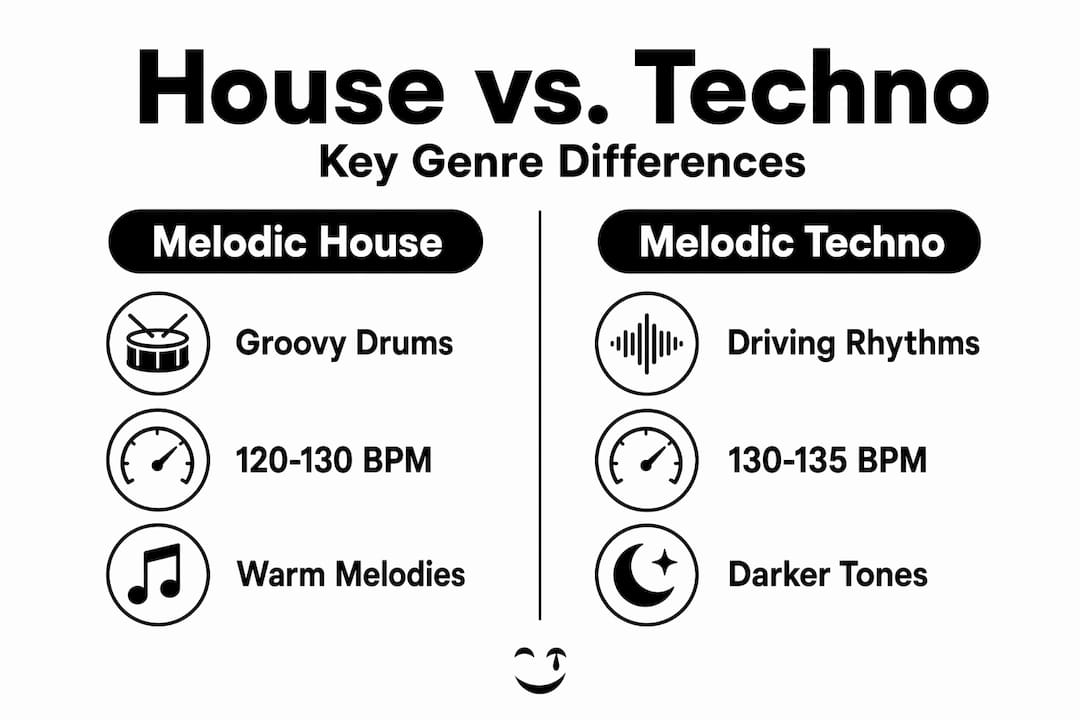
The clearest comparison is with melodic techno. Both genres use arpeggiated synths, cinematic builds, and emotionally driven sound design. However, genre overlap and ambiguity between these styles means BPM alone is not sufficient to distinguish them. The real difference lies in structure and intent. Melodic techno tends to be more hypnotic and groove-focused, often running at slightly higher BPMs and favoring a more relentless, driving rhythm. Melodic house, by contrast, keeps the swinging, groove-oriented house beat at its center and gives more room to harmonic development.
Here is a direct comparison of the key genres:
| Feature | Melodic house | Melodic techno | Progressive house |
|---|---|---|---|
| Typical BPM | 120 to 130 | 130 to 140 | 125 to 132 |
| Rhythm style | Four-on-the-floor, groovy | Driving, relentless | Flowing, layered |
| Melody emphasis | Very high | High | Moderate to high |
| Emotional tone | Warm, nostalgic | Dark, intense | Euphoric, uplifting |
| Breakdown style | Lush, atmospheric | Hypnotic, minimal | Grand, sweeping |
| Audience reception | Intimate and emotional | Club-focused | Festival-oriented |
Understanding the difference between house and techno at a foundational level makes these distinctions much clearer. Techno, even in its melodic form, tends to prioritize the machine-like pulse and groove over harmonic storytelling. House music, including melodic house, puts the human emotional experience at the center.
Progressive house is another close neighbor. It shares the extended builds and layered sound design, but progressive house often leans toward euphoria and festival-scale drama. Melodic house is more intimate. It rewards close listening and creates a more personal emotional connection.
Pro Tip: When you are trying to classify a track, focus on three things: the drum pattern (is it a groovy house kick or a driving techno pulse?), the breakdown (does it feel warm and melodic or hypnotic and dark?), and the overall emotional intent (intimate and nostalgic, or intense and relentless?). These three markers will get you further than BPM alone. Part of what makes melodic house so catchy and emotionally resonant is this precise balance between dancefloor energy and harmonic depth.
The roots and evolution of melodic house
With those distinctions laid out, it is vital to look back at how this sound formed and evolved. Melodic house did not appear out of nowhere. It grew from a convergence of influences that were already reshaping electronic music in the early 2010s.

As noted in its Wikipedia entry, melodic house draws on progressive house and early-2010s deep house roots while retaining house structure and beat orientation. That lineage is crucial. Deep house contributed the warm, soulful harmonic sensibility. Progressive house contributed the extended builds and emotional arc. Trance, though rarely acknowledged directly, contributed the arpeggiator-driven melodic intensity.
Here is a timeline of key developments in the genre’s evolution:
- Late 1990s to early 2000s: Progressive house and trance begin blending melodic complexity with dancefloor energy, laying the groundwork for what will follow.
- Early 2010s: A new wave of producers starts combining deep house warmth with more elaborate melodic structures. Labels like Anjunadeep become key platforms for this emerging sound.
- Mid-2010s: The genre gains a name and a dedicated following. Streaming platforms begin categorizing it as “melodic house and techno,” which creates some of the genre confusion that persists today.
- Late 2010s to early 2020s: Technology plays a major role. More accessible digital audio workstations and synthesizers allow producers worldwide to craft the lush, layered sounds that define the genre. The palette broadens considerably.
- 2020s: Melodic house reaches global audiences, with artists from Europe, South America, and Africa bringing regional influences into the sound.
“The history of house music is a story of constant evolution. Melodic house is one of its most emotionally sophisticated chapters.”
The genre’s connection to the origins of house music is worth appreciating. House music was always about feeling. It was built in Chicago clubs by DJs who wanted to create something that moved people emotionally as much as physically. Melodic house honors that original spirit by pushing the emotional dimension even further. It takes the groove and the pulse of classic house and adds layers of harmonic storytelling that can feel genuinely moving.
The influence of top deep house tracks is especially audible in melodic house. That warm, chord-driven approach to production, where the music feels like it is breathing, carries directly into the melodic house sound. Artists like Lane 8, Ben Böhmer, and Nora En Pure built their reputations by refining this approach, creating tracks that feel simultaneously club-ready and deeply personal.
How to spot melodic house: practical tips for fans and DJs
Understanding the past and present of melodic house helps, but let us get specific. Here is how you can spot a true melodic house track on your own, step by step.
- Start with the kick drum: Is it steady, four beats per bar, with a warm, slightly swinging feel? That is your house foundation. A harder, more mechanical kick points toward techno territory.
- Listen for the arpeggios: Melodic house almost always features rapid, repeating note sequences that climb and descend through chord tones. If you hear that shimmering, cascading quality, you are likely in melodic house territory.
- Evaluate the breakdown: Melodic house breakdowns are lush and atmospheric. They feel like the track is opening up emotionally. If the breakdown feels cold or hypnotic rather than warm and expansive, it may be melodic techno.
- Notice the harmonic content: Does the track use rich chord progressions that feel nostalgic or emotional? Melodic house tends to favor warm, resonant harmonies over stark or dissonant ones.
- Feel the overall groove: Melodic house makes you want to move in a fluid, organic way. It has a pulse that feels human and warm, not mechanical or relentless.
Common traps to avoid:
- Confusing cinematic builds with melodic house: Some melodic techno tracks have equally dramatic builds. The difference is in the groove underneath.
- Assuming all arpeggio-driven tracks are melodic house: Trance uses arpeggios heavily too, but at much higher BPMs and with a different rhythmic feel.
- Over-relying on streaming platform labels: Platforms often group “melodic house and techno” together, which blurs the lines. Trust your ears over the tag.
As established genre references point out, tracks categorized as melodic house may be difficult to separate from melodic techno because both can be melody and arpeggiator-driven with cinematic builds. The key is to focus on lineage and structural orientation rather than expecting a strict BPM cutoff.
Pro Tip: Build a reference playlist of tracks you know are definitively melodic house. Use those as your ear training anchors. When a new track feels ambiguous, compare it directly to your reference tracks and ask which world it feels closer to. Exploring identifying house music in depth will sharpen your ear quickly. You can also browse house tracks on Beatport to find well-labeled examples that help calibrate your listening.
Why melodic house’s blurry boundaries are a strength, not a weakness
Here is a perspective that often gets lost in genre debates: the ambiguity around melodic house is not a flaw in the genre. It is one of its greatest assets.
Many fans and even some DJs want strict genre lines. They want to know exactly what box a track fits into before they decide how to feel about it. That impulse is understandable, but it misses something important. The most memorable DJ sets and the most exciting musical discoveries happen precisely at the edges, where melodic house bleeds into melodic techno, or where deep house warmth seeps into a progressive build. Those moments of genre tension create surprise, and surprise is what keeps a dancefloor alive.
The fluid boundary between house and techno has always been a creative engine. Producers who refuse to stay on one side of that line consistently make the most interesting music. When a melodic house track borrows the relentless drive of techno for one section and then opens into a warm, harmonic breakdown, it creates an emotional contrast that neither genre could achieve alone.
From a DJ’s perspective, playing with genre ambiguity is a skill. Mixing a melodic house track into a set that has been building through deeper, darker sounds creates a moment of release that feels earned. That transition only works because the genres are close enough to share a language but different enough to create contrast. Rigid classification would eliminate that possibility entirely.
The real magic of melodic house is that it refuses to be pinned down completely. It lives in the space between the analytical and the emotional, between the groove and the melody, between the club and the concert hall. That is not confusion. That is creative freedom.
Discover the world of house music with Play House
Ready to take your appreciation of melodic house further? Play House, the Paris-based DJ and producer, curates musical journeys that move through the full spectrum of house music, from the warm grooves of deep house to the rhythmic energy of afro house.

Explore the origins of house music to understand the roots that feed every subgenre you love. Dive into the full house music history to see how melodic house fits into a much larger, richer story. And if you want to feel the energy of house music in its most vibrant, rhythmic form, the best afro house playlist is an essential listen. Play House brings all of these worlds together with a refined ear and a genuine passion for the music.
Frequently asked questions
Is melodic house the same as melodic techno?
No, melodic house and melodic techno have overlapping features but are distinguished mainly by beat structure and intent. As genre references note, melodic house emphasizes house beat orientation and groove-driven patterns, while melodic techno leans toward a more driving, hypnotic pulse.
What is the typical BPM range for melodic house?
Melodic house tracks typically fall between 120 and 130 BPM, with 128 BPM being especially common. According to Wikipedia’s genre overview, tempos generally sit around 120 BPM and do not exceed approximately 130 BPM.
Why are genre lines often blurred between house and techno styles?
Modern music production blends genres more than ever, so intent, structure, and rhythm determine classification more reliably than BPM alone. As Double Clap’s genre analysis explains, melodic house frequently blends with neighboring styles, making structural listening the most reliable approach.
Which artists or labels are known for melodic house?
Labels like Anjunadeep and artists such as Lane 8, Ben Böhmer, and Nora En Pure are widely associated with melodic house, known for their lush productions and emotionally driven sound design.
Recommended


